How Did Florence Kelley Address Workers' Rights and Family Life?
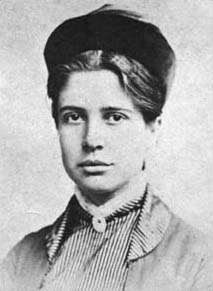
| Florence Kelley | |
|---|---|
 | |
| Born | Florence Moltrop Kelley (1859-09-12)September 12, 1859 Philadelphia, Pennsylvania, US |
| Died | February 17, 1932(1932-02-17) (aged 72) Philadelphia, Pennsylvania, US |
| Alma mater | Cornell Academy Northwestern University Schoolhouse of Law |
| Occupation | American social reformer |
| Spouse(south) | Lazare Wischnewetzky |
| Parent(s) | William D. Kelley and Caroline Bartram Bonsall |
Florence Moltrop Kelley (September 12, 1859 – February 17, 1932) was a social and political reformer and the pioneer of the term wage abolitionism. Her work against sweatshops and for the minimum wage, eight-hr workdays,[ane] and children's rights[2] is widely regarded today.
From its founding in 1899, Kelley served every bit the offset general secretary of the National Consumers League. In 1909, Kelley helped to create the National Clan for the Advancement of Colored People (NAACP).
Early life [edit]
On September 12, 1859, Kelley was built-in to William D. Kelley (1814–1890) and Caroline Bartram Bonsall in Philadelphia.[3] Her father was a cocky-fabricated man who became an abolitionist, a founder of the Republican Party, a judge, and a longtime member of the US Firm of Representatives.
Kelley was influenced mainly by her father and said, "I owe him everything that I have ever been able to learn to do."[iii] Throughout her early on years, he read books to her that involved child labor.[three] Even at 10, she was educated by her father on his activities, and she was able to read her father'south volume, The Resources of California.[3]
Caroline Bartram Bonsall, Kelley's mother, was non a less-prominent effigy. Bonsall had relations to the famous Quaker botanist, John Bartram. Unfortunately, Bonsall'due south parents died while at a young age, she was then adopted by Isaac and Kay Pugh.[3]
Kelley spent many happy years with her grandparents Isaac and Kay Pugh.
Kelley's great-aunt, Sarah Pugh, lived as a Quaker and opponent of slavery. Pugh'southward decision to deny use of cotton wool and sugar because of the connection to slave labor made an impression on Kelley from an early historic period.[iv] Pugh was an advocate for women and told Kelley about her life as an oppressed woman.[3]
Kelley had two brothers and five sisters; all v sisters died in childhood. Three of the sisters were Josephine Bartram Kelley, Caroline Lincoln Kelley, and Anna Caroline Kelley. Josephine died at the age of ten months. Caroline died at the age of four months. Anna died at the age of six years.
Kelley was an early supporter of women's suffrage after her sisters died and worked for numerous political and social reforms, including the NAACP, which Kelley helped found. In Zurich, she met various European socialists, including Smoothen-Russian medical student Lazare Wischnewetzky, whom she married in 1884 with whom she had three children;[five] the couple divorced in 1891. She wanted a divorce considering of his concrete corruption[three] and overflowing debt.[4] Unable to divorce her husband for "not-back up," she fled to Chicago and received full custody of her children.[4] She kept her maiden proper name simply preferred to be called "Mrs. Kelley."[3]
Education [edit]

In her early years, she was severely ill and highly susceptible to infections and so was unable to go to school for a menstruum of fourth dimension.[3] On days that she would miss school she would be in her father's library and read many books.
In 1882, Kelley attended Cornell University at age sixteen.[3] At Cornell, she was a Phi Beta Kappa member.[4] There, she wrote her thesis about disadvantaged children. The topic of her thesis was influenced by her father's didactics about underprivileged children.[3]
Although Kelley desired to study law at the University of Pennsylvania, she was denied to nourish because of her sex.[three] In the meantime, she pursued her passion for working women by founding and attending evening classes at the New Century Guild for Working Women.[4] Later, she attended the University of Zurich, the first European university to grant degrees to women, and she joined a grouping of students advocating socialism.[4]
Kelley also earned a law degree at Northwestern University School of Police in 1894.[4] She was and then able to start a schoolhouse for working girls in Pennsylvania.[3]
Socialism and civil rights [edit]

Kelley was a member of the Intercollegiate Socialist Society, an activist for women'south suffrage and African-American ceremonious rights. She was a follower of Karl Marx and a friend of Friedrich Engels. Her translation, of the latter's The Condition of the Working Grade in England into English language in 1885 is still used today. She appears at that place as "Mrs. F. Kelley Wischnewetzky" and was also known as Florence Kelley.
She assisted with the establishment of the New Century Guild of Philadelphia, forth with Gabrielle D. Clements and led by Eliza Sproat Turner. It had classes and programs to assist working women.[6] Kelley herself taught evening classes at that place.[four]
The New Century Guild intended to increase the quality of working and living status of the lower class in urban areas.[7] The organization helped lead the boxing for labor laws, such as the minimum wage and the viii-hour days, at the local, country, and federal levels.[4] In Chicago, Kelley organized the New York Working Women'south Society Campaign in 1889 and 1890 "to add women as officials in the office for factory inspection".[8] By 1890, the New York legislature passed laws creating eight new positions for women every bit land factory inspectors.
Kelley joined the Hull House from 1891 to 1899. The Hull House allowed Kelley to accelerate in her career by providing her a network to other social organizations and an outlet to pursue the advancement of rights for working women and children.[8] While at the Hull Business firm, Kelley bonded with Jane Addams and Julia Lathrop, who worked together every bit major labor reformers. All three women were of upper-middle-class background and had politically active fathers.[eight] She also became friends with Grace and Edith Abbott likewise as Alice Hamilton, a professional physician specialized in preventing occupational diseases.[9] Kelley interacted with the Chicago Women's Club nether Jane Addams' sponsorship by establishing a Bureau of Women's Labor. Hull House provided Kelley the opportunity to featherbed male organizations in order to pursue social activism for women, who were denied participation in formal politics at the time. She is credited with starting the social justice feminism movement.[x]
In 1892, Kelley investigated the labor conditions of Chicago's garment industry past persuading Illinois Bureau of Labor Statistics to hire her. During that same twelvemonth, she conducted a survey of Chicago's slums per the asking of U.S. Commissioner of Labor, Carroll D. Wright,.[iv] The survey uncovered children from three-years-old working in "overcrowded tenement apartments". The survey also revealed women overworked past burnout, workers risking pneumonia, and children with burns.[4]
Kelley contributed to a multifariousness of social organizations including National Child Labor Committee, National Consumers League, National Briefing of Social Workers,[seven] American Sociological Association, National American Adult female Suffrage Clan, NAACP,[11] Women's International League for Peace and Freedom,[iv] and the Intercollegiate Socialist Society.
Factory inspection and child labor [edit]
Kelley'southward father had toured her through glass factories at nighttime when she was young.[12] Kelley fought to make it illegal for children nether the age of xiv to work and to limit the number of hours for children under 16. She sought to give the children the right of educational activity, and argued that children must be nurtured to be intelligent people.
From 1891 through 1899, Kelley lived at the Hull House settlement in Chicago. Kelley took the initiative by taking state legislatures on tours of sweatshops. She persuaded labor and civic groups to lobby on behalf of the reform legislation. In 1893, she became the first adult female to hold statewide office when Governor Peter Altgeld appointed her to the postal service of Chief Factory Inspector for the land of Illinois, a newly created position and unheard-of for a woman.[13] She chose five women and vi men to assistance her.[14] Hull Firm resident Alzina Stevens served equally one of Kelley's assistant factory inspectors.[15] In the course of her Hull Firm work, she befriended Frank Alan Fetter when he was asked past the University of Chicago to conduct a study of Chicago neighborhoods. At Fetter'south move, she was made a fellow member of Cornell's Irving Literary Society as an alumna, when he joined the Cornell Faculty.[three]
Kelley was known for her firmness and tearing energy. Hull House founder Jane Addams' nephew called Kelley "the toughest customer in the reform riot, the finest rough-and-tumble fighter for the adept life for others, that Hull House ever knew."[16]
Kelley was appointed Special Agent of the Illinois State Agency of Labor Statistics when she proposed investigating the "sweating system", "the practice of contracting out work to homes of the poor," in Chicago. In her report, she discovered employees working up to 16 hours a day, 7 days a calendar week with some wages that are not high enough to back up the family.[14]
By 1893, the Illinois legislature passed the outset factory police force limiting work for women to eight hours a 24-hour interval and prohibiting the employment of children under the age of fourteen.[4] [10] In the same year, Illinois passed protective labor laws, distinguishing the start of the Progressive Era in social reform.[ten]
NAACP and work on racial equality [edit]
Asked by William English Walling and Mary White Ovington, Kelley became a founding fellow member of the NAACP. As a member of the board of directors, she belonged to committees on Nomination, The Budget, Federal Help to Education, Anti-Lynching, and the Inequality Expenditure of Schoolhouse Funds.[thirteen] Co-ordinate to W.E.B. DuBois, Kelley was well known for request pointed questions to find a form of activeness.[13] Her public discussions covered black people in churches, social welfare forums, and social inequality.
In 1913, she studied the federal patterns of distribution of funds for instruction. She noticed a lot of caitiff distributions for white schools as opposed to blackness schools.[13] That launched her to create the Sterling Discrimination Nib, which was an attack against the Sterling Towner Beak, which proposed a federal sanction of $2.98 per capita for teachers of colored children and $ten.32 per capita children at white schools in xv schools in the South and Washington, D.C. The NAACP held the position that it would perpetuate the continual bigotry and neglect of the public schools for blackness people. She and W. E. B. DuBois disagreed on how to assault this bill. She wanted to add the language that guaranteed equitable distribution of funding regardless of race. DuBois believed that in that location should be a clause added specific to race because it would require the federal authorities to enforce that the schools for black people to exist treated adequately.
Kelley believed that if anything was added almost race to the bill, information technology would non pass through Congress. She wanted to go the bill passed and so to change the language. Therefore, when the beak was passed, it called for equal distribution to the schools to be handled by the states based on population. The issue remained on whether or not the states would distribute the money every bit.
Kelley disagreed with the NAACP and W.E.B. DuBois on other bug as well. The Sheppard-Towner Act was the about contentious result of disagreement betwixt them. The deed provided help to mothers and children during pregnancy and infancy. The NAACP and DuBois were opposed to the pecker because there were no provisions to prevent the discrimination in the distribution of funds to black mothers. Unlike her stance on equitable distribution of educational funds, Kelley was not enervating any provisions for equitable distribution, equally she knew the bill would never pass if the issue of race was introduced, particularly with the opposition already nowadays from southern states. Kelley believed that it was more important to laissez passer the legislation, fifty-fifty in its express form, and so that the funding would be secured and the primary principle of social welfare would be established. Somewhen, Kelley, earned the back up of the NAACP on the upshot with the promise to monitor the nib if information technology passed and to work tirelessly toward the equity of all, regardless of race.[thirteen]
In 1917, she marched in the New York silent protestation parade, opposing the violence of white citizens against black people in the East St. Louis, Illinois, race riots of that yr.[13] To pressure level anti-lynching onto Congress, she appealed National Women's League of Voters to back up the Dryer Anti-Lynching Nib in 1922. Despite the League's lack of activeness, Kelley provided a serial of letters to Arthur B. Spingarn of the NAACP in 1926 about the many cases of lynching in the United States. To gain support from the media, Kelley also suggested for newspaper editors who opposed lynching to exist published.
Kelley used her ability in Congress by her personal connections to avoid discrimination from being passed in laws, specially toward expenditure toward school funds. In 1921, she pushed the Board of Directors of the NAACP to oppose bills that discriminate based on race in expenditure toward school funds. Kelley is famous for creating the tradition of protest against racial discrimination, which occurred in the mid-20th century.
With the release of "Nativity of a Nation," Kelley and other NAACP leaders demonstrated in numerous cities against the film for representing a racist interpretation of black people. In 1923, Kelley struggled for admission of the National Association of Colored Women as members of the Women'southward Joint Congressional Commission, which formed in 1920.[thirteen] She succeeded by January 1924, when fifteen of 17 organizations included NACW members.
National Consumers League and eight-hour day [edit]
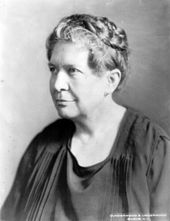
From 1899 through 1926, she lived at the Henry Street settlement business firm on New York City. From there, she founded and acted equally General Secretarial assistant of the National Consumers League, which was strongly anti-sweatshop.[17] [4] She used her management to raise public awareness and pass state legislation to protect workers, primarily for women and children.[iv] The Consumers' League established a Code of Standards that served to raise wages, shorten hours, and required a minimum number of sanitary facilities.[9] Kelley used the NCL to address her ain policies such equally local hours and wages of women via information collection and activism.[ten] Kelley too served equally a mentor to younger activists, such every bit Mary van Kleeck, who briefly worked for the Consumers League.[18]
In her work there, she congenital 64 Consumers Leagues to promote and to pass labor legislation.[nineteen] Kelley often acted as a representative to address land legislators and expanded the NCL network through women'south clubs. She worked difficult to establish a workday limited to eight hours. In 1907, she threw her influence into a Supreme Court case, Muller five. Oregon, an attempt to overturn limits to the hours female workers could work in non-hazardous professions. Kelley helped file the famous Brandeis Brief, which included sociological and medical bear witness of the hazards of working long hours and fix the precedent of the Supreme Courtroom's recognition of sociological evidence, which was used to bully effect later in Brown v. Lath of Pedagogy.[20] Her pursuit to enforce the 8 hour work day for women was after declared unconstitutional by the Illinois Supreme Courtroom in 1895 considering it restricted women from making contracts for longer hours.[21]
In 1909, Kelley helped create the NAACP and thereafter became a friend and ally of W. East. B. Du Bois. She also worked to help improve child labor laws and working weather condition.[22]
In 1917, she again filed briefs in a Supreme Court case for an eight-hour workday, at present for workers "in any mill, factory or manufacturing institution," in the case Bunting five. Oregon.[23]
Kelley'south NCL sponsored a "Consumer's 'white characterization'" on vesture that restricted garment product with kid labor and working conditions against state constabulary. She led the National Consumers League until her death, in 1932.
Other accomplishments [edit]
In 1907 Kelley organized New York'due south Committee on Congestion of Population, afterward which she and Mary Kingsbury Simkhovitch sponsored an showroom on the causes and consequences of congestion and methods for alleviating it, catalyzing the offset National Briefing on City Planning in 1909.[24] Kelley worked with Josephine Goldmark to make the Brandeis Brief to demonstrate the harmful effects of overtime on women's health.[4] The action helped support arguments in Muller 5. Oregon in 1908, although the Supreme Courtroom ruled against the women laundry workers in the case.[25]
Kelley besides helped vestibule Congress to pass the Keating-Owen Child Labor Act of 1916, which banned the auction of products created from factories that employed children thirteen and under. In addition to this act, she also lobbied for the Sheppard-Towner Act, which created the nation's first social welfare program to fight against maternal and infant bloodshed by funding health intendance clinics specialized in those areas.
In 1912, she formed the Usa Children's Bureau, a federal agency to oversee children's welfare.
Expiry [edit]
Kelley died, age 72, in the Germantown section of Philadelphia on February 17, 1932. She is buried at Philadelphia'south Laurel Colina Cemetery.[26]
She was named an Angel hero by The My Hero Projection.[12]
Publications [edit]
The responsibility of the consumer. New York City: National Child Labor Committee, 1908.[27]
Kelly argues that it is the responsibleness of the consumer to utilise their buying power to discourage moral ills regarding work conditions, such every bit kid labor. Succinctly put, she argues for the mod phrase, "vote with your dollar." Further, in order to estimate labor conditions, she argues that citizens must demand adequate statistics about such conditions from their land and federal governments.
The Nowadays Status of Minimum Wage Legislation. New York City: National Consumers' League, 1913.[28]
Provides a brief history of the beginnings of minimum wage legislation in England and the U.s.. Kelley cautions usa against cartoon up too quickly a hastily and poorly written police force such that a courtroom may strike it downwards thereby setting a precedent for similar laws. Finally, Kelly briefly explores how order ultimately bears the cost for not paying a sufficient minimum wage, through caring for the poor and through the maintenance of prisons.
Modern Industry: in relation to the family, health, education, morality. New York: Longmans, Green 1914.
Women in Industry: the Eight Hours Day and Rest at Night, upheld by the United States Supreme Courtroom. New York: National Consumers' League, 1916.
Xx Questions about the Federal Amendment Proposed by the National Woman's Party. New York: National Consumers' League, 1922.
Notes of Threescore Years: The Autobiography of Florence Kelley. Chicago: C.H. Kerr Pub. Co., 1986.[29]
The Need of Theoretical Training for Philanthropic Work. 1887.[29]
Kelly emphasizes the need for a theoretical groundwork prior to engaging in philanthropic work. Without such background, she argues, the blazon of philanthropic work chosen volition most likely reproduce the electric current capitalist socioeconomic arrangement that leads to the demand for philanthropic work in the get-go place. In essence, one needs theoretical grooming in club to treat the causes rather than the symptoms.
She argues for this by distinguishing between 2 types of philanthropy: bourgeois philanthropy and philanthropy of the working class. Conservative philanthropy "aims to requite back to the workers a little fleck of what our social organisation robs them of, propping upwards the system longer," (92) thus information technology is fundamentally palliative, preserving the current arrangement in identify. Philanthropy of the working class, on the other paw, aims to weaken the backer system through goals such as shortening the work twenty-four hour period and limiting the working of children. These measures result in a lower amount of surplus value produced which is antithetical to the capitalist arrangement.
After such a theoretical preparation, Kelley concludes that existent philanthropic work consists in elevating course consciousness.
References [edit]
- ^ Kathryn Kish Sklar, "Florence Kelley," Women Building Chicago, 1790-1990: A Biographical Dictionary, Rima Lunin Schultz and Adele Hast, eds., Indiana Academy Press, Bloomington, Indiana, 2001, p. 463
- ^ Margolin, C.R. (1978) "Salvation versus Liberation: The Movement for Children's Rights in a Historical Context," Social Bug. 254. (Apr), pp. 441-452
- ^ a b c d e f g h i j k fifty m n Josephine Goldmark, Impatient Crusader: Florence Kelley's Life Story (1953); Dorothy Blumberg, Florence Kelley and the Making of a Social Pioneer (1966).
- ^ a b c d due east f 1000 h i j k l one thousand n o p Dreier, Peter (2012). "Florence Kelley". New Labor Forum. i: 71–76. doi:10.4179/NLF.211.0000011. S2CID 153894180.
- ^ Kelley, F. 1986. The Autobiography of Florence Kelley, Notes of Sixty Years. Chicago: Charles Kerr. p. 9.
- ^ Anne H. Wharton (January–December 1892). "Business concern Training and Opportunities for Women". Arthur'southward Dwelling house Magazine. Vol. 62. Philadelphia: T.S. Arthur & Sons. p. 113.
- ^ a b Timming, Andrew R. (2004). "Florence Kelley: A Recognition of Her Contributions to Folklore". Journal of Classical Sociology. 4 (3): 289–309. doi:x.1177/1468795X04046969. S2CID 145006141.
- ^ a b c Sklar, Kathryn Kish (1985). "Hull Business firm in the 1890s: A Community of Women Reformers". Signs. x (iv): 658–677. doi:x.1086/494177. JSTOR 3174308. S2CID 144726094.
- ^ a b Perkins, Frances (1954). "My Recollections of Florence Kelley". Social Service Review. 28 (1): 12–xix. doi:x.1086/639501. JSTOR 30019232. S2CID 144075882.
- ^ a b c d Woloch, Nancy (2015). A Class past Herself. Princeton University Press. p. vi.
- ^ Athey, Louis L. (1971). "Florence Kelley and the Quest for Negro Equality". The Journal of Negro History. 56 (4): 249–261. doi:ten.2307/2716966. JSTOR 2716966. S2CID 150176400.
- ^ a b "The My Hero Project - Florence Kelley". myhero.com.
- ^ a b c d e f g Athey, Louis L. (1971). "Florence Kelley and the Quest for Negro Equality". The Journal of Negro History. 56 (4): 249–261. doi:10.2307/2716966. JSTOR 2716966. S2CID 150176400.
- ^ a b Kelley, Florence (1859-1932). (2009). In J. Sreenivasan, Poverty and the government in America: a historical encyclopedia. Santa Barbara, CA: ABC-CLIO. Retrieved from https://products.abc-clio.com/abc-cliocorporate/product.aspx?pc=A1679C
- ^ Davis, Allen F. "Stevens, Alzina Parsons" Notable American Women Vol. 3, 4th ed., The Belknap Press of Harvard University Press, 1975
- ^ James Weber Linn, Jane Addams: A Biography, University of Illinois Press, 2000, p. 138
- ^ Sklar, p. 464
- ^ Hendrickson, Marker (2013-05-27). American Labor and Economic Citizenship: New Capitalism from World State of war I to the Great Depression. Cambridge University Printing. pp. 155–159. ISBN9781107028609.
- ^ Fee, Elizabeth; Brown, Theodore M. (2005). "Florence Kelley: A Mill Inspector Campaigns Confronting Sweatshop Labor". American Journal of Public Health. 95 (1): l. doi:x.2105/AJPH.2004.052977. PMC1449850. PMID 15623858.
- ^ Sklar, pp. 465
- ^ Sklar, p. 463
- ^ "Center for the Historical Written report of Women and Gender". binghamton.edu. Archived from the original on 2007-eleven-02.
- ^ Sklar, pp. 465-466
- ^ Caves, R. Due west. (2004). Encyclopedia of the Metropolis. Routledge. pp. 409–410. ISBN9780415252256.
- ^ Garraty, Quarrels That Accept Shaped the Constitution, "The Instance of the Overworked Laundry Workers"
- ^ Social Welfare History Project
- ^ Kelley, Florence (1908). "The Responsibility of the Consumer". The Annals of the American Academy of Political and Social Scientific discipline. 32 (22_suppl): 108–112. doi:10.1177/000271620803202214. JSTOR 1010993. S2CID 145100553.
- ^ Kelley, Florence (1913). "The Present Condition of Minimum Wage Legislation" (PDF). Proceedings of the National Conference of Charities and Correction. National Consumers' League.
- ^ a b Kish., Sklar, Kathryn; Congress), Paul Avrich Collection Library of (1986-01-01). Notes of sixty years : the autobiography of Florence Kelley ; with an early essay past the author on the demand of theoretical preparation for philathropic work. Published for the Illinois Labor History Society by the C.H. Kerr Pub. Co. pp. 91–104. ISBN0882860933. OCLC 13818491.
Further reading [edit]
- Blumberg, Dorothy Rose. Florence Kelley. The Making of a Social Pioneer. (1966)
- Goldmark, Josephine. Impatient Crusader: Florence Kelley's Life Story (1953)
- Grinspan, Jon. The Age of Acrimony: How Americans Fought to Fix Their Democracy, 1865 - 1915. Bloomsbury Publishing. 2021.
- Sklar, Kathryn Kish. Florence Kelley and the Nation'southward Work: The Rise of Women's Political Culture, 1830-1900. New Oasis and London: Yale Academy Press. 1995.
- Sklar, Kathryn. Notes of Sixty Years: The Autobiography of Florence Kelley, Charles H. Kerr Publishing Company. 1986.
Sources [edit]
- Amico, Eleanor B., ed. Reader'southward Guide to Women'south Studies (Fitzroy Dearborn, 1998)
- Sklar, Kathryn Kish, and Beverly Wilson Palmer, eds. The Selected Messages of Florence Kelley, 1869–1931 (Urbana: Academy of Illinois Press, 2009). lxii, 575 pp. ISBN 978-0-252-03404-6
External links [edit]
- Women and Social Movements in the The states, 1600-2000. "How Did Florence Kelley'south Campaign against Sweatshops in Chicago in the 1890s Aggrandize Regime Responsibleness for Industrial Working Weather condition?"
External links [edit]
- Works by Florence Kelley at Project Gutenberg
- Works by or about Florence Kelley at Internet Archive
- Works by Florence Kelley at LibriVox (public domain audiobooks)

- The Life and Times of Florence Kelley in Chicago (1891-1899) on Northwestern University
- Florence Kelley (1859-1932) on harvard.edu
- Kelley Kelly on schoolnet.co.great britain
- Florence Kelley on Women and Social Movements, subscription required
- Biographical note [ permanent dead link ]
- A letter of the alphabet from Engels to Florence Kelley Wischnewetzky
- Entry at 'project Muse' (needs a subscription to read information technology all)
- Florence Kelley fought for civil rights
gallegosqueng1989.blogspot.com
Source: https://en.wikipedia.org/wiki/Florence_Kelley
0 Response to "How Did Florence Kelley Address Workers' Rights and Family Life?"
Post a Comment